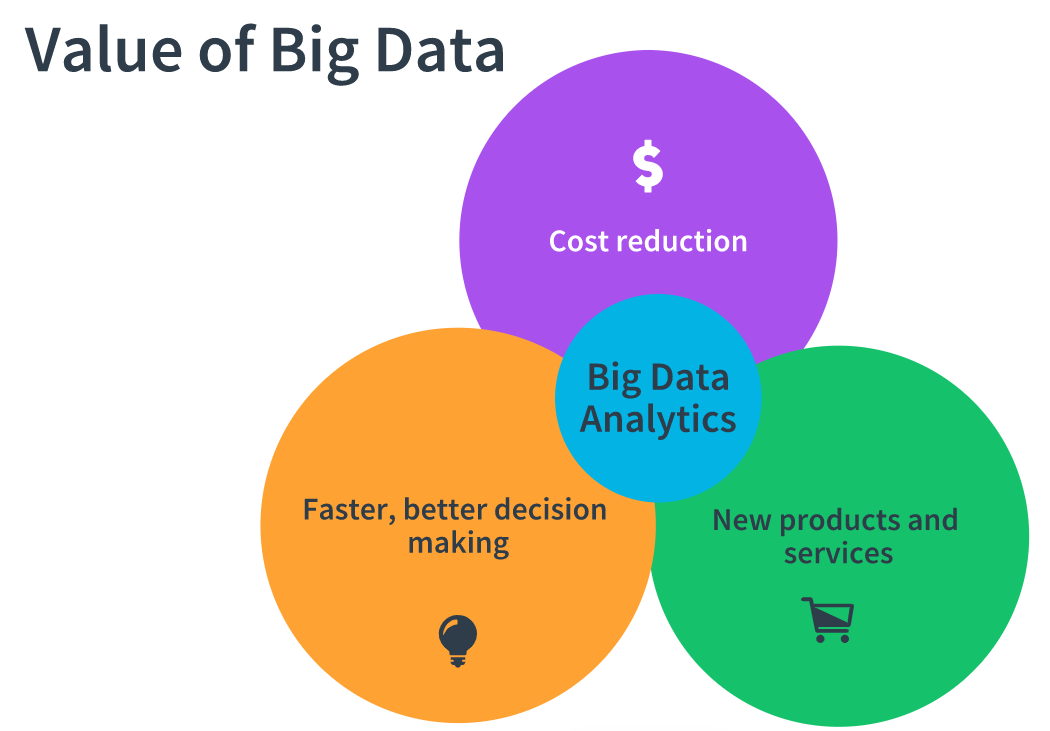
Big Data refers to the very large and complex datasets that cannot be handled efficiently by traditional databases or tools.
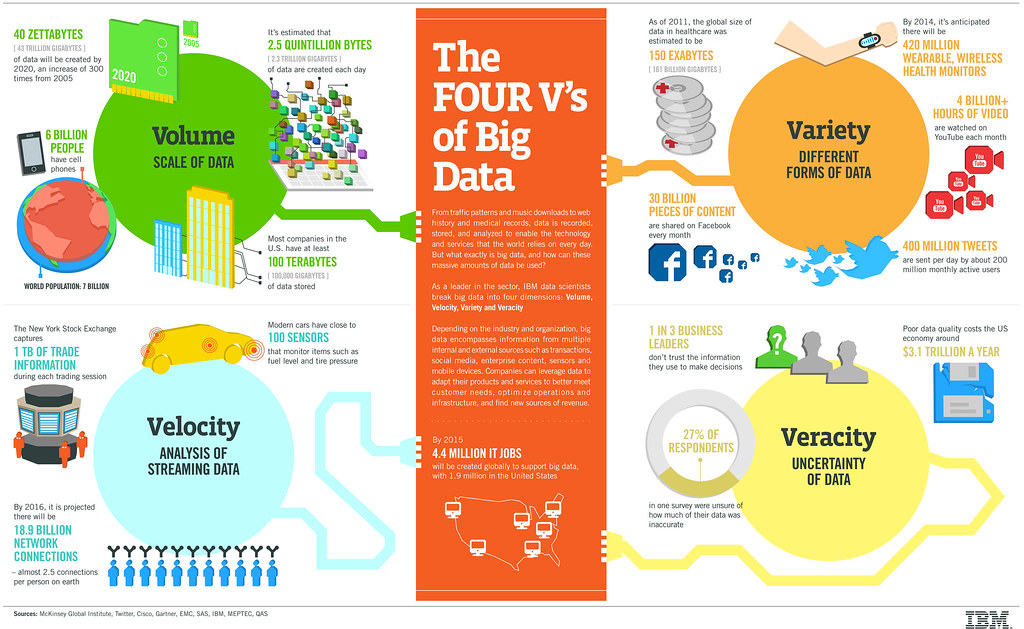
It is characterized by the 3 V's
- Volume: The amount of data is enormous (in terabytes (1000GBs), petabytes (1000TBs)). For example social media generates billions of post/content (data) everyday
- Velocity: The speed at which data is generated and processed is very high. Think of real-time data streams from IoT devices, stock market, livestreaming
- Variety: Data comes in different formats:
- Structured: Relational Databases, tables
- Semi structured: JSON, XML, CSVs
- Unstructured: Images, videos, emails PDFs
Some also add Veracity (accuracy) and Value (usefulness), making it 5 V's
Need of Big Data
Big Data enables organizations to:
- Improve Decision-Making: Insights from data help companies predict trends, detect frauds, and enhance customer experiences
- Innovate Products: Recommendation models uses there datasets for training there models
- Optimize Processes: Businesses analyze supply chain or operations data to improve efficiency
Examples of Big Data in Action
-
Social Media:
Platforms like Facebook and Twitter analyze user activity to show relevant ads. -
E-Commerce:
Amazon processes customer purchase histories to suggest products. -
Healthcare:
Analyzing patient data to predict disease outbreaks or personalize treatment. -
Banking:
Fraud detection using transactional data patterns. -
Smart Cities:
Traffic management systems process data from sensors to reduce congestion.
Challenges of Big Data
-
Storage:
How do we store such massive datasets?
(Solution: Distributed systems like Hadoop’s HDFS). -
Processing:
How do we analyze huge datasets efficiently?
(Solution: Frameworks like Hadoop MapReduce and Apache Spark). -
Scalability:
Systems must scale up as data grows.
(Solution: Cloud services and Distributed Computing.)
Big Data Tools
- Hadoop: Distributed storage and batch processing.
- Spark: Faster, in-memory data processing.
- Hive: SQL-like querying on big data.
- Kafka: Real-time data streaming.
- NoSQL Databases: MongoDB, Cassandra for unstructured data.
Big data is not a single tech, but more so an entire field.
It provides ways to work with massive data sets that are too large or complex to be dealt with by traditional data-processing application software.
Big data provides values in different ways:
- Improve product and services
- Cost reduction and revenue increase
- Faster, better decision making by executive teams
- Using data to identify new opportunities leads to smart business moves, more efficient operations higher profits and happier customers.