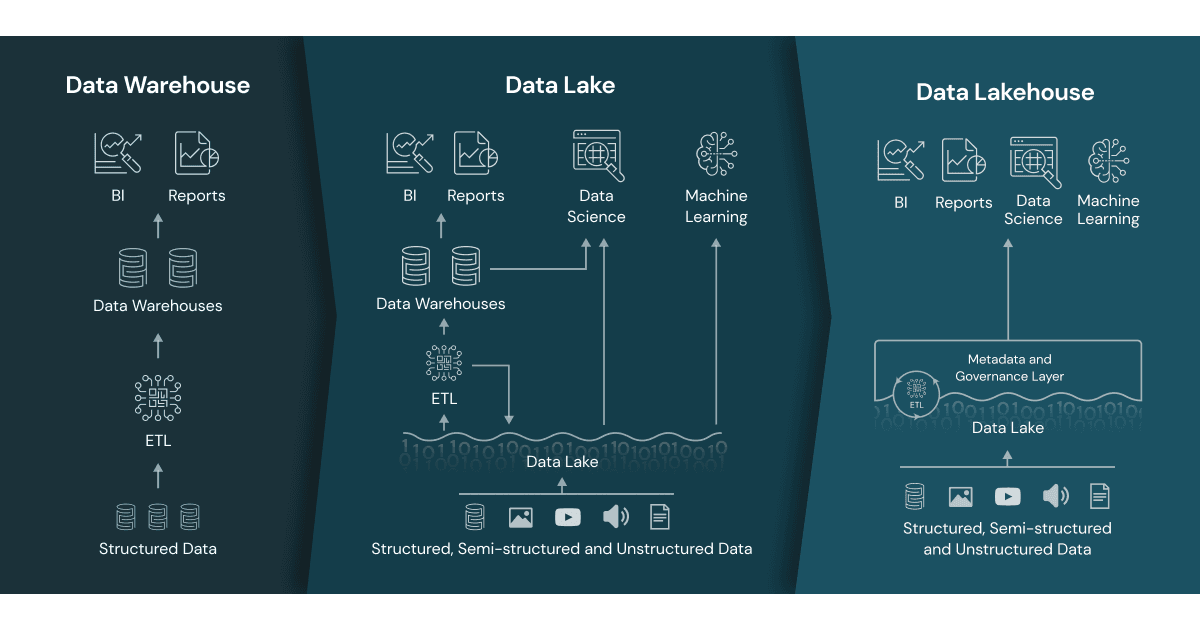
Data Lakehouse is a unified data architecture that combines the best of both Data Lakes and Data Warehouses. It stores data in an open format with low storage cost, as a Data Lake does, while also providing ACID Transactions and data integrity, which are key features of a Data Warehouse.
The reason Data Lakehouse was introduced is that earlier architectures relied on a two-tier system (Data Lake + Data Warehouse), which created multiple challenges. Organizations had to maintain separate storage layers and infrastructure, leading to higher costs. Data had to be moved through multiple ETL pipelines, increasing engineering complexity. This also caused data duplication and staleness, as analytics was performed on delayed, processed data instead of real-time data. The lakehouse solves this by unifying storage and processing into a single platform.
3 Layer Architecture
Data Lakehouse achieves these features by adding data-warehouse capabilities directly on top of low-cost lake storage. It can be broken into 3 layer architecture.
Storage Layer (Foundation)
- Use cheap storage, (GCS, S3, ADLS) same as data lake
- Data is stored in open formats such as parquet or ORC
Table Format Layer
- Open table formats like Delta Lake, Apache Iceberg, or Apache Hudi sit on top of raw files.
- They add critical warehouse features directly to the lake:
- ACID Transactions — reliable reads/writes
- Schema Enforcement & Evolution — prevents bad data from entering
- Time Travel — query historical snapshots of data
- Data Versioning — rollback to previous states
Metadata & Governance Layer
- A metadata catalog (e.g., Unity Catalog, AWS Glue, Hive Metastore) tracks schemas, lineage, ownership, and access policies.
- Enables fine-grained access control, auditing, and data discovery.
Compute/Query Engine Layer
- Decoupled from storage — compute scales independently.
- Optimized SQL engines (Spark SQL, Photon, Presto, Trino) provide warehouse-level query performance on lake data.
Consumption Layer
- A single copy of data serves both:
- BI & SQL Analytics (dashboards, reports)
- Data Science & ML (feature engineering, model training)
A Data Lakehouse is a unified architecture that combines the low-cost storage of data lakes with the reliability and performance of data warehouses. It removes the need for separate systems by adding capabilities like ACID transactions, schema enforcement, and time travel directly on top of data lake storage, enabling both BI and ML workloads on a single source of data.